
Bead count per well is part of your protocol, not a detail. If A1 gets two 3 mm zirconia beads and H12 gets one, those two samples were not homogenised the same way, and nothing downstream repairs it. Loading a 96-well plate by hand with forceps or a scoop takes 20 to 30 minutes and produces exactly that spread. A gravity mesh loader fills the same plate in about 8 seconds, one bead per well, on a single pull of the slider.

We carry three different bead loaders and we get asked which one to use often enough that the question deserves a proper answer rather than a spec sheet. So here it is: how to choose a bead size, the four loading methods labs actually use, and the failure modes we see often enough to warn customers about before they order.
Why the count matters more than most people expect
Beadbeating works by kinetic energy transfer. Bead mass, bead count and fill volume together set how much energy reaches your sample in a given run. Change the count and you change the outcome.
In a 96-well plate this shows up as edge effects that look like biology. A technician loading by hand tends to be careful at the start of the plate and quicker by row F. Wells with a stray second bead lyse harder and can shear DNA. Wells that were missed entirely come back with poor yield, and because the plate was loaded before the samples went in, nobody can tell afterwards which wells those were.
That is the part labs underestimate. A loading error is silent.
Which bead size for which sample
Bead choice is sample-dependent, and our bead selection guidelines go into the biology properly. The short version of where most protocols land:
| Sample | Typical bead | Notes |
|---|---|---|
| Bacteria, yeast | 0.1 to 0.5 mm glass or zirconia/silica | Below 0.3 mm a mesh loader is the wrong tool, see below |
| Soft animal tissue | 1.0 to 2.0 mm zirconia or glass | One or two beads per well |
| Tough tissue, muscle, skin | 2.3 to 3.2 mm chrome steel or zirconia | Mass does the work here |
| Plant leaf, seed, root | 3.2 to 6.35 mm chrome steel | Often a single large bead per well |
| Soil, sediment | Garnet or silicon carbide sharp particles | Grading matters more than nominal size |
The limits are worth stating plainly, because they save a phone call. A mesh loader works by letting each bead fall through one opening, so it needs beads larger than the well opening below and consistent in diameter. The LabTie loader covers 0.3 to 6.0 mm. Below 0.3 mm no mechanical loader helps, ours included, so for 0.1 mm glass in a bacterial lysis protocol buy pre-filled tubes and spend the money somewhere it does something.
Two more boundaries, both involving beads we stock.
6.35 mm needs a mesh cut to order. The standard LabTie openings stop at 6.0 mm, and our 6.35 mm chrome steel and glass beads sit just above that. Plant labs use those constantly, one large bead per deepwell. It is not a refusal, it is a made-to-order mesh plate. If you are buying beads and a loader from us together, say the beads are 6.35 mm and we will have the matching mesh built rather than shipping a 6.0 and sorting it out afterwards.
Sharp particles will not work. Garnet and silicon carbide are graded fractions of irregular media, not spheres. They do not seat one to an opening and no mesh geometry fixes that. Scoop those, or dose them by volume.
Four ways labs load beads
Forceps, one bead at a time. Accurate, and nobody who has done a full plate wants to do a second one. 20 to 30 minutes per plate. It is also the method most likely to be quietly abandoned halfway through a busy week.
Scoop and level. Fast for volume-based loading into deepwell plates, useless when the protocol calls for a fixed count. Fill volume varies with how the beads packed that morning.
Fill and flip. A template plate is filled, levelled and inverted over the target plate. Good, cheap, and it works, provided the two plates line up and nothing bounces on the flip. Static on dry plastic is the usual complaint.
Gravity mesh. A plate of drilled openings sits above the target. Fill the reservoir, tilt to level it, seat it on the plate and pull the slider once. Every opening drops its bead at the same moment.
We sell all three of the mechanical options. Which one is right depends on how often you run plates and whether your protocol specifies a count or a volume.
What the gravity loader actually does
The mechanism is not clever, which is the point. No power supply, no software, nothing to calibrate.
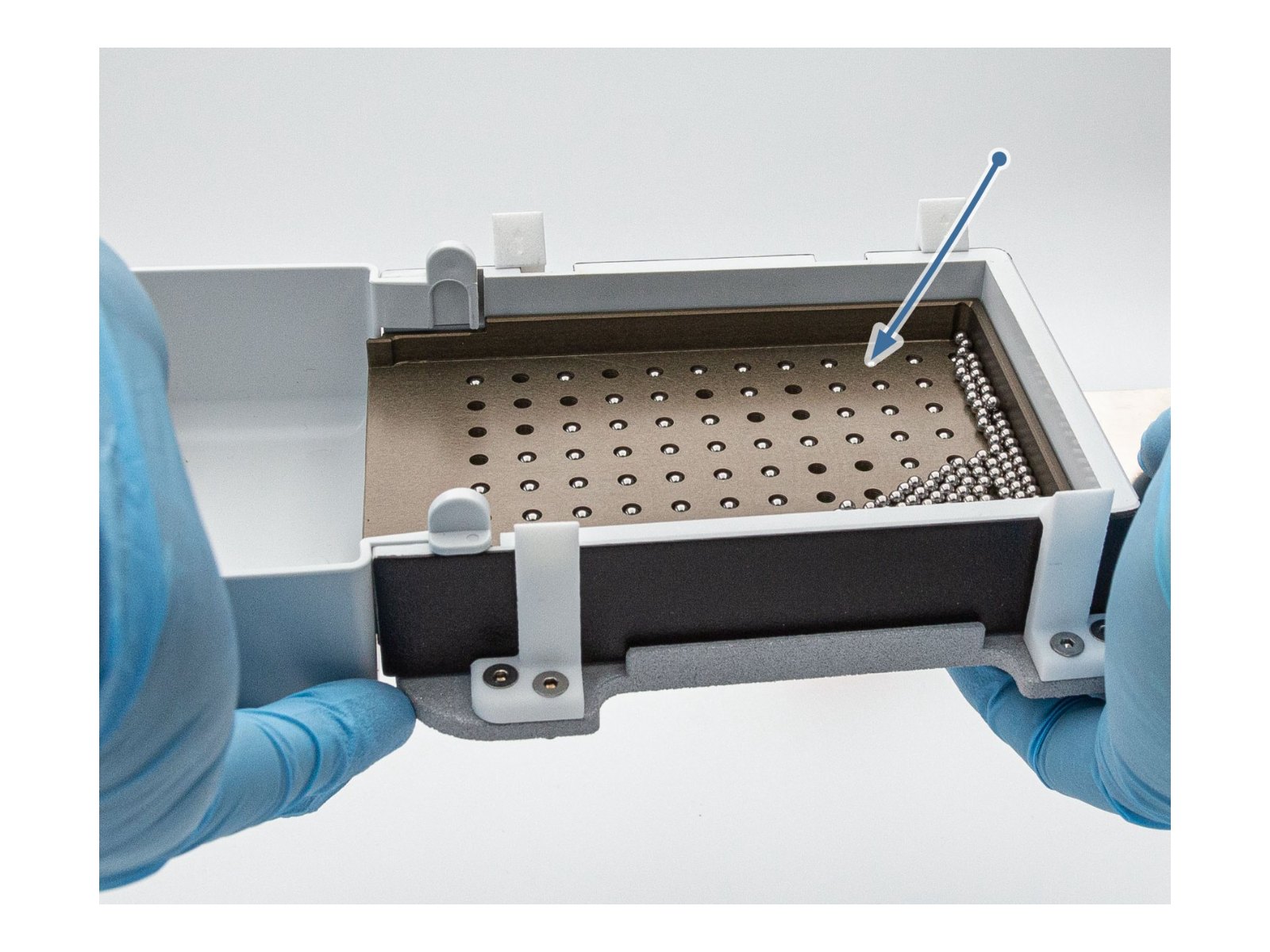
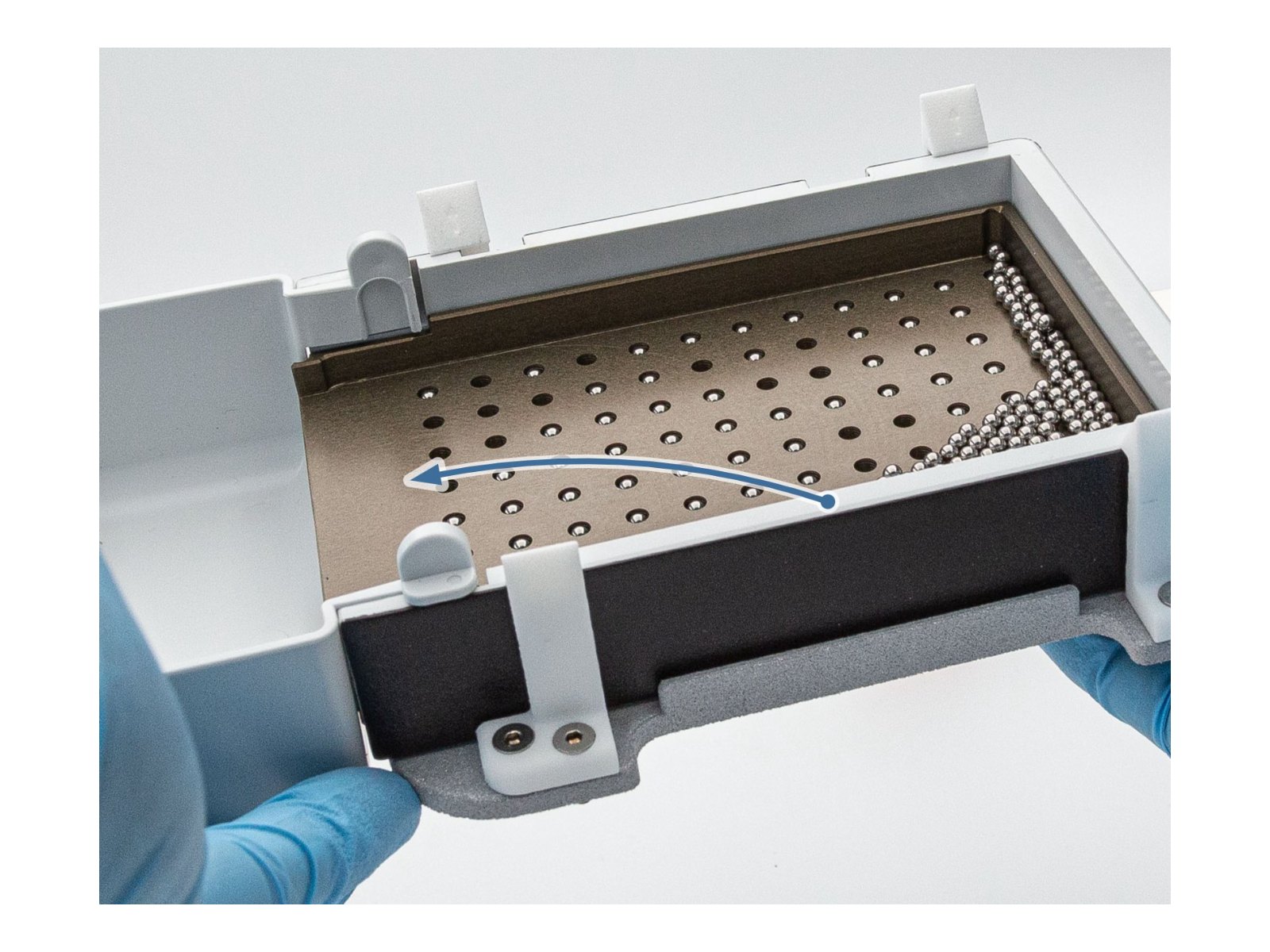

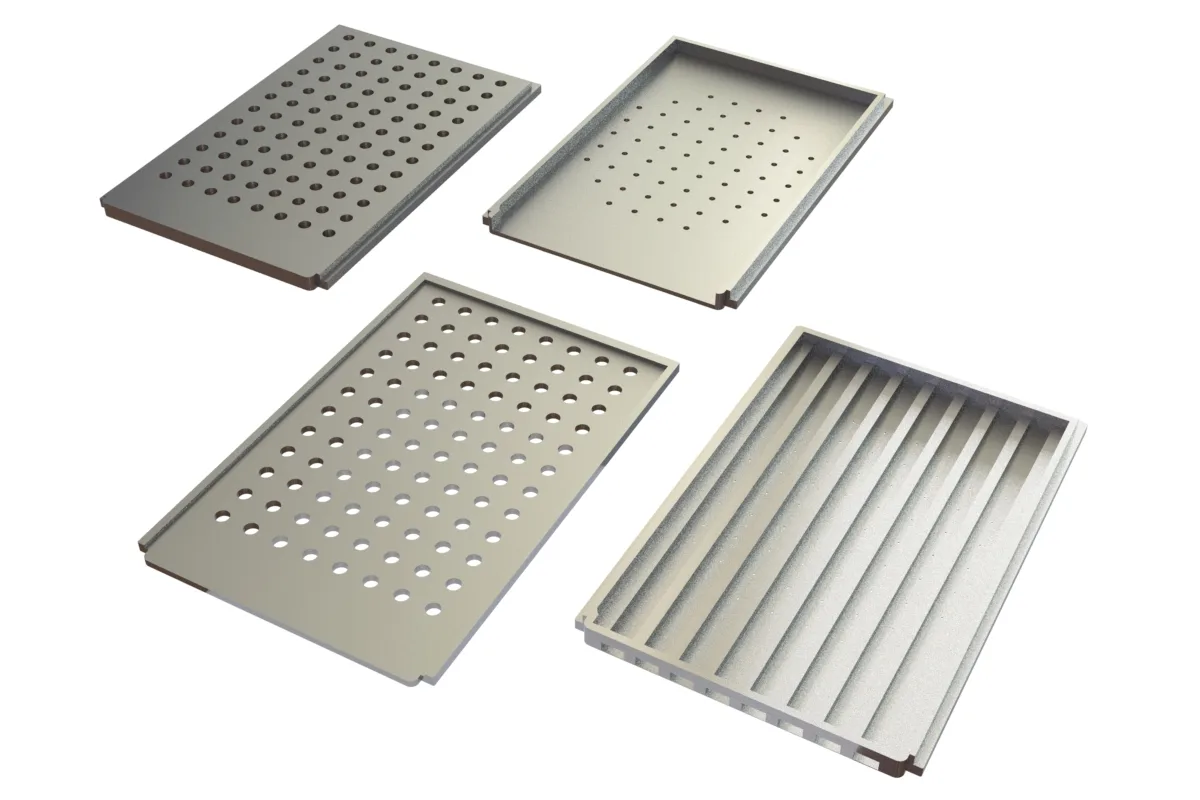
The mesh plate is the whole instrument. LabTIE cuts nine standard openings: 0.8, 1.0, 2.0, 2.5, 3.0, 3.2, 3.96, 4.7 and 6.0 mm. Openings outside that list are cut to order, and so are openings that hold two, three or up to six beads per well when a protocol calls for it. Changing bead size means swapping the mesh plate, about as involved as changing a pipette tip.
The body seats on ANSI/SLAS footprint plates at 9.00 by 9.00 mm pitch. LabTIE has verified fit on Greiner, Corning, Thermo Nunc, Sarstedt, Eppendorf and Bio-Rad plates in microtiter, round bottom and square deepwell formats. Every part that touches beads autoclaves at 121°C and takes a 70% ethanol wipe between runs.
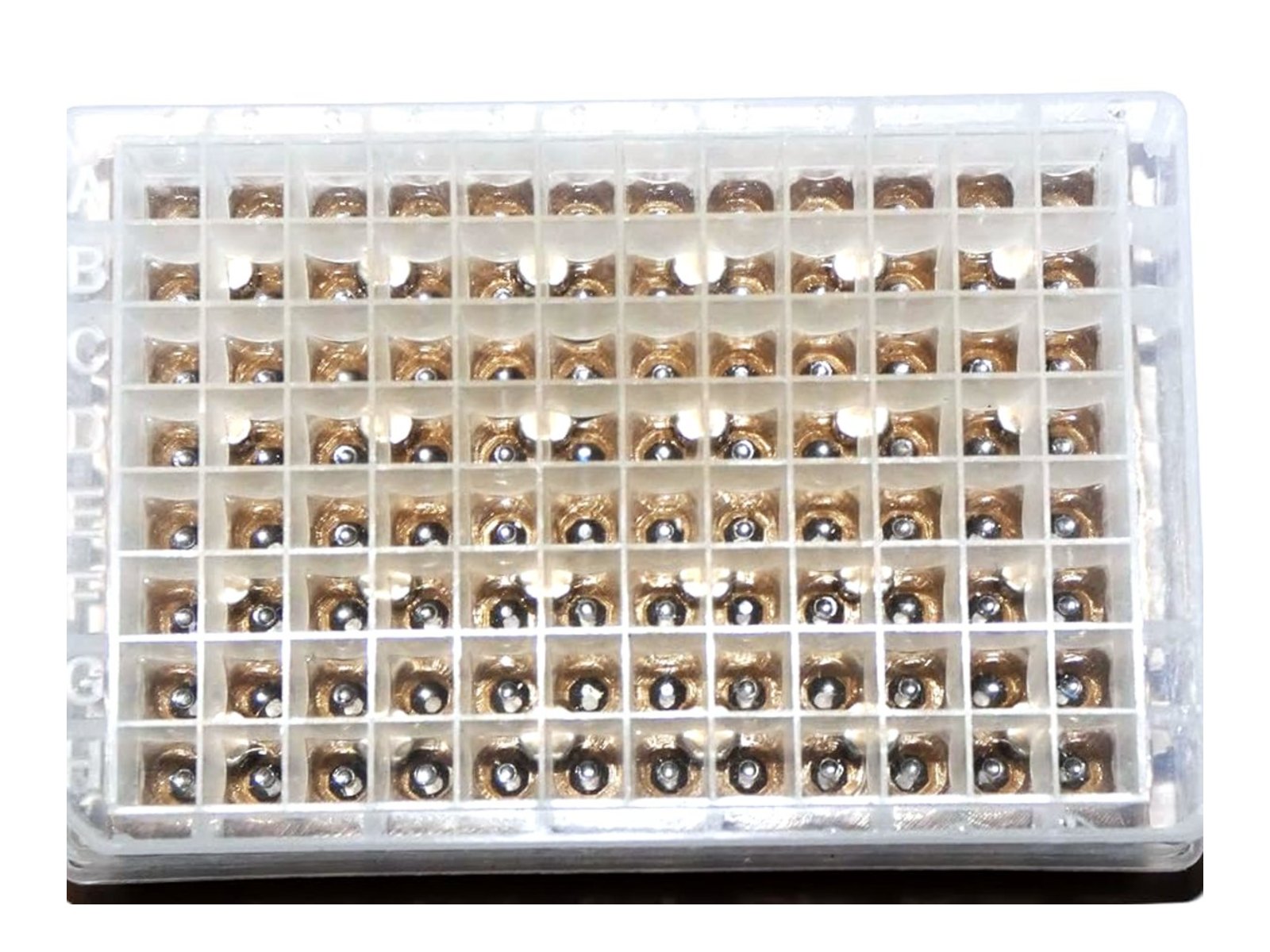
On uniform, graded beads a full 96-well plate loads in about 8 seconds with no empty wells. On beads with a loose diameter tolerance, it does not. That distinction is the most useful thing in this article, so it gets its own section.
Five things that go wrong
Ungraded beads. This is the big one. A mesh opening sized for a 3.0 mm bead assumes your beads really are 3.0 mm. Unsorted bulk media carries a wide diameter tolerance, and then the undersized beads pair up in one opening while the oversized ones bridge and skip. If a loader is giving you inconsistent fills, sieve a sample before blaming the loader. Graded lab-grade beads behave. Industrial media sold by the kilo often does not.
Static. Dry plastic in a low-humidity room holds light beads against the wall of the mesh. Glass and polymer suffer worst, steel barely at all. An antistatic mat, or running the plate in a room that is not bone dry, clears it.
Hygroscopic material bridging. More of a powder problem than a bead problem. Damp powder arches above the opening and the column stops moving. It looks like a jam and it is really a moisture problem.
Wrong plate seating. Round bottom plates and square deepwell plates have different rim geometry. The loader has to sit flat or beads roll between wells. If yours rocks, the plate brand is probably not one that has been tested, and LabTIE would rather cut a matching seat than have you shim it with tape. Tell us the brand and we will pass it on.
Expecting it to replace a balance. It does not. Volume-based dosing repeats to under 1% CV across positions, which is fine for grinding media and for most reagent dosing. For gravimetric work with a documented mass per sample, weigh it. We will tell you the same thing on the phone.
The same mechanism handles seeds and powders
The loader does not know what is falling through it. Change the mesh and it dispenses other things, which is why the LabTIE line comes in three versions.
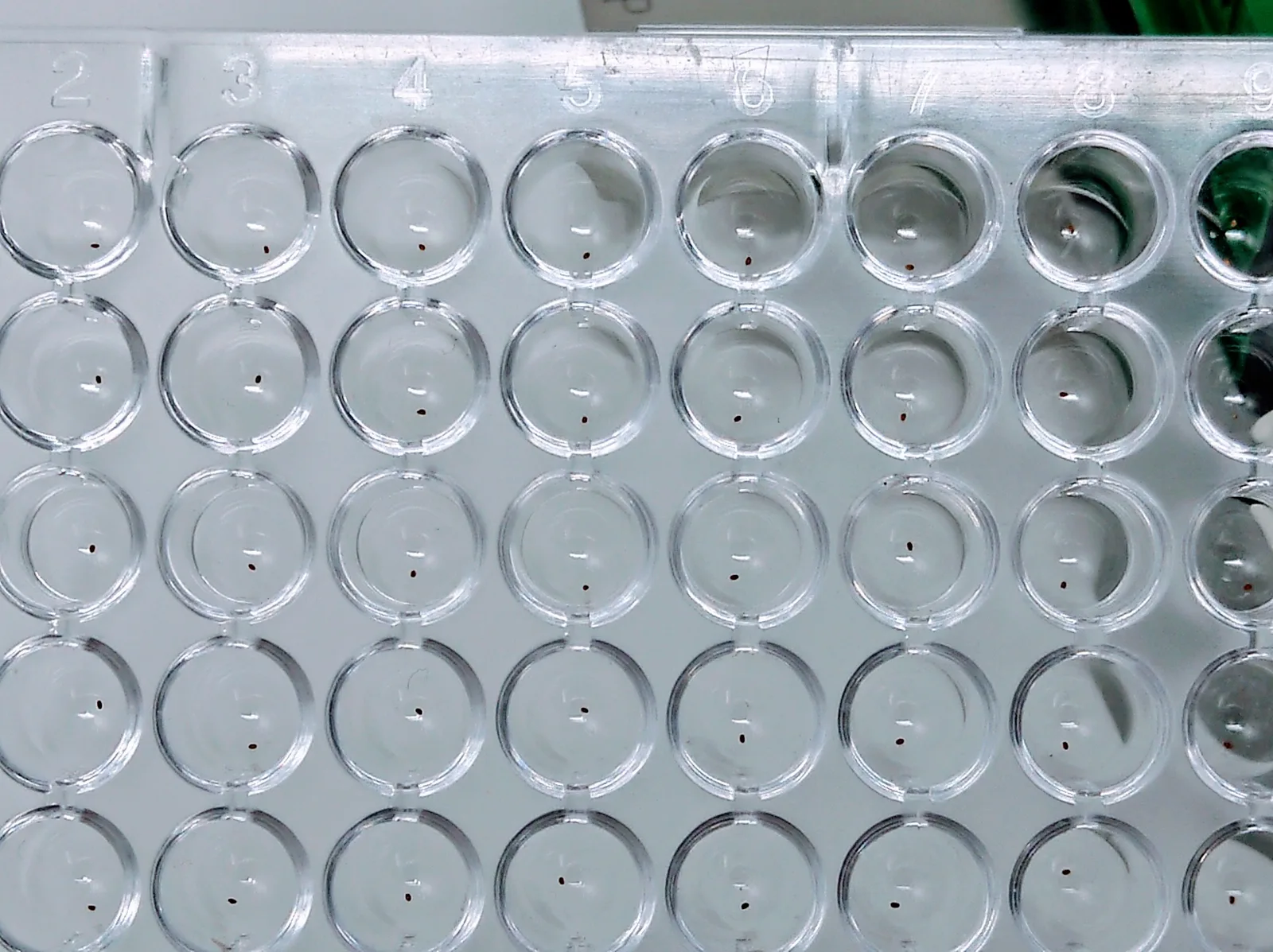
Seed dispensers cover 0.2 to 9.0 mm and about 120 seed types, from onion and lettuce down to Arabidopsis thaliana at 0.3 to 0.5 mm. A full tray takes roughly 45 seconds with under 1% empty positions. Groups running germination or seed DNA extraction report 10 to 20 times the plate output per technician-hour against forceps or a moistened toothpick.
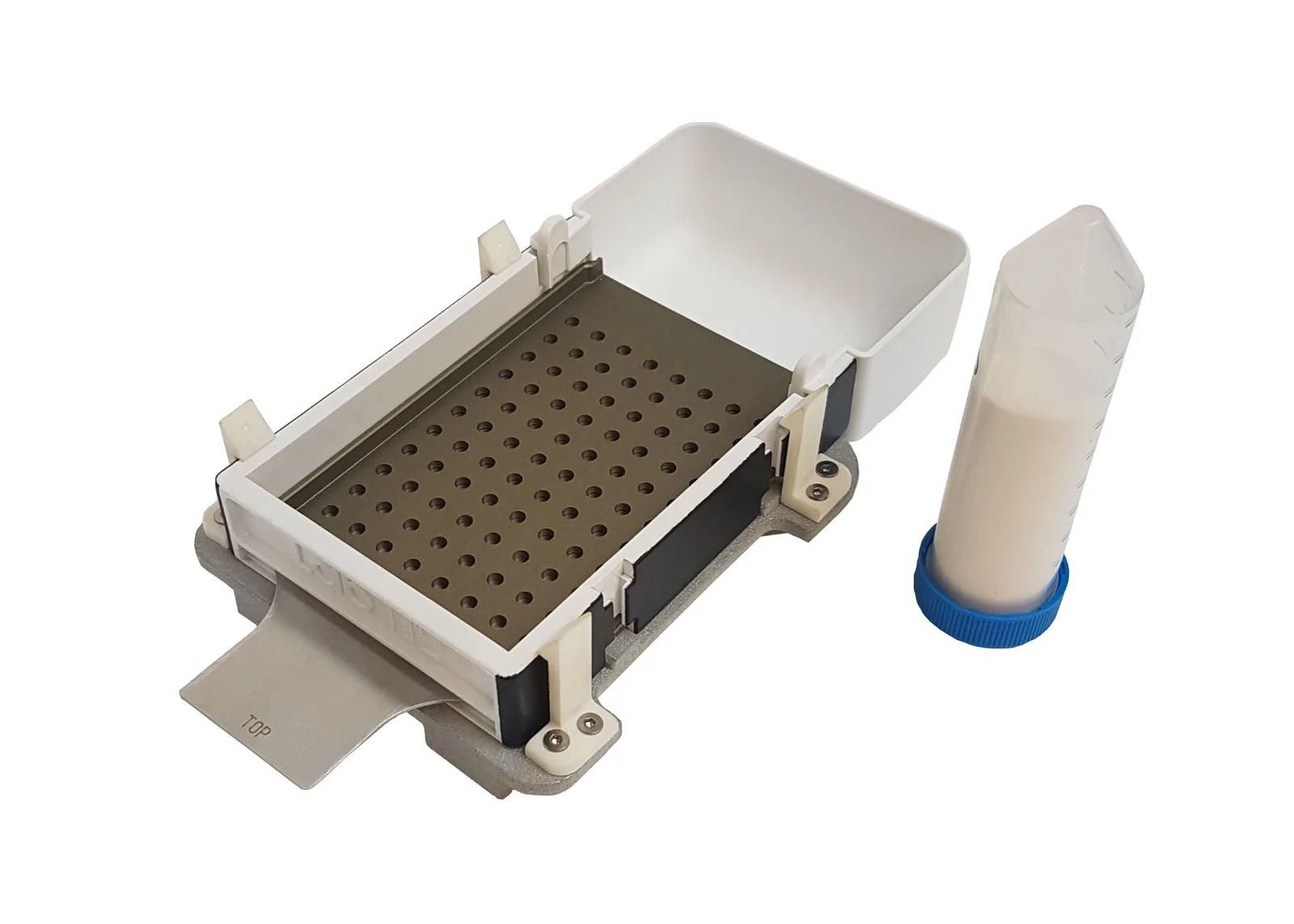
Powder dispensers dose 10 to 1000 µL per position, up to 1500 µL on some mesh configurations, into 24, 45, 48, 96 and 384 formats. Same slider, same 45 seconds, same caveat about the balance.
The bead version is the one most of our customers want, and the 96-Well Bead Dispenser fits most extraction workflows straight out of the box.
If your container is not standard, send us the plate or the vial. Every dispenser is designed, built and tested in house in Doorn, so cutting a mesh around an unusual tube is a normal job there rather than a special project. Send a sample of your beads too. They get measured before a mesh size is quoted, for the reason given above.
After the beads are in
The loader stops where the mill starts, and the two have to agree on format. That sounds obvious until somebody buys a loader for deepwell plates and a homogeniser that only takes 24 vials.
Our own range makes it straightforward. The Mini-BeadBeater-96 takes a 2 mL deepwell plate, two 1 mL plates, or 45 microvials, which are the same two formats as the most requested LabTie loaders. For vial work, the Mini-BeadBeater-16 ULTRA and the Mini-BeadBeater-24 ULTRA hold 16 and 24 screwcap microvials, and both now run at around 68 dB rather than 82.
Ask us which one suits your batch size. Getting the loader and the mill to agree on a rack is a two minute conversation now and a five year annoyance later.
Where to buy
Two addresses, split by region. No overlap, no competing on price, so order from whichever is nearer.
United States, Canada and Mexico
BioSpec Products, Bartlesville, Oklahoma. We are the distributor for North America and we stock the LabTie Gravity Bead Loader alongside the beads and the homogenisers, so bead material, bead size, loader and mill can be settled in one conversation instead of three. Made-to-order units run about four to five weeks.
Europe and the rest of the world
LabTIE International, Doorn, the Netherlands. Outside North America, order the loaders direct from the manufacturer. They are built in Doorn, so for European labs there is no ocean in the middle: quotes come back within one working day, standard units ship within a few business days by DHL Express, and European delivery usually lands inside one to two weeks. Custom formats are quoted the same way.
One change worth knowing about, since it affects who answers your email. LabTIE International returned to its original ownership in 2026 after several years inside a larger group. Same product line, same workshop in Doorn, and a shorter route from a question to the person who built the thing.
Questions we get asked
How many beads per well should I use?
Sample and bead size decide it, and our bead selection guidelines are the reference. Mechanically the loader will place one to six beads per well depending on which mesh plate is fitted, so pick the protocol first and the mesh second.
Does it work with deepwell plates?
Yes, square deepwell and round bottom both, on ANSI/SLAS footprint at 9.00 by 9.00 mm pitch. Tell us your plate brand when you order and the seat gets confirmed before the unit is built.
Can I use the same unit for 1 mm and 3 mm beads?
Yes. Swap the mesh plate. The body stays the same and the swap takes seconds.
Can I use 6.35 mm beads?
Yes, with a mesh cut to order. Standard openings stop at 6.0 mm, so say 6.35 mm when you order and the right plate gets made.
Is it autoclavable?
Every bead-contact part goes to 121°C. Between runs, 70% ethanol on a cloth is enough.
Where do I buy one?
In the United States, Canada and Mexico, from us. Everywhere else, direct from LabTIE International in the Netherlands.
How much faster is it, really?
About 8 seconds against 20 to 30 minutes for the same plate by forceps. The time saved matters less than the fact that well 96 is loaded the same way as well 1.
About LabTIE International
LabTIE International designs, builds and tests manual laboratory dispensers in Doorn, the Netherlands. One mechanism, three versions: bead, seed and powder. Everything is made in house, which is why an unusual tube or plate is a normal job there rather than a special project.
The company returned to its original ownership in 2026 after several years inside a larger group. Same product line, same workshop, shorter route from a question to the person who built the thing.
BioSpec Products is the distributor for the United States, Canada and Mexico. Everywhere else, LabTIE sells direct.
- Address
- Van der Leelaan 15, 3941 RN Doorn, the Netherlands
- Website
- labtie.com
Written by Jeff Anderson at BioSpec Products, Bartlesville, Oklahoma. Dispenser figures and photographs supplied by LabTIE International, who manufacture the LabTie Gravity Bead Loader.